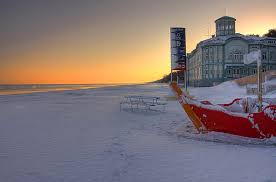
 Halloween. The time when the undead come to town. And when boarded up haunted houses start making eerie sounds and come alive. This year, however, not all of them seem that decrepit and spirited. Some in fact remain relatively quiet. These are the haunted houses of Schengen. Haunted, yet alluring. Indeed, they can be quite luxurious. They also do not appear in creepy places (So no Castles in Transylvania – not yet. at least, for Romania is still waiting to join Schengen…). On the contrary, they rise along swanky neighborhoods or exclusive beach resorts. Who lives there? Hmmm, good question. If we had an answer, these houses would not be haunted… A more pertinent question is: why would anybody in their sane mind be so foolish as to own such as a ghostly abode? Wait a minute: it’s Schengen, stupid! Yes, what makes these architectural ghosts so attractive is that they happen to be in the most sought-after place on earth, namely Europe (Yes, some find the decadent Old Continent still attractive!). And if you are not a European citizen and require a visa to enter Eurodreamland, then why not buy your way into paradise by claiming a fictitious residence there? And here enters Jurmala, the Latvian resort city by the Baltic Sea. In 2010, the Latvian government introduced a program that allows foreign citizens to acquire residency in the country if they are willing to invest at least 71,000 euros. Minimum requirement to maintain residency: have a local address (an apartment in Jurmala sounds good!) and be there one day per year (yeah, the day the haunted houses of Schengen come alive!). And who cares about the sandy beaches (The Baltic sea is not the Caribbean after all). With a local residency in your pocket, the doors of Europe are open to you! No more hassle at EU embassies! No more dealing with these callous and ungrateful European officials! To good to be true. Indeed, in three years, around 7,000 ‘zombies’, mostly well-healed Russians, Chinese and Kazakhs, have taken advantage of this unique opportunity. But like everything else, good things are bound to come to an end. Latvia is now feeling a bit of pressure from its EU partners (should we blame them?) to close this loophole. And they might have another reason to do so. Purportedly, the rationale for this program is to encourage money flows into the country. Yet this money is often laundered and sent back to the ghost’s (ehmm, resident’s) country of origin. So much for Latvia’s gains! None should that surprised then if this year’s Halloween might seal the program’s fate: R.I.P the Haunted Houses of Schengen!
All posts by schengenizer
Jurmala’s ghosts and the Haunted Houses of Schengen
Posted by schengenizer on October 31, 2013
https://schengenalia.com/2013/10/31/jurmalas-ghosts-and-the-haunted-houses-of-schengen/
The place to be: Schengen and Europe’s new grand tour
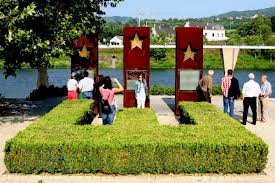 The way ‘Schengen’ has captured the popular imagination around the world does not finish surprising me. After all, not that long ago the term only referred to a sleepy little village along the river Moselle, known for its wine, and not much else. And then came the omonimous (and infamous) treaty that led the way to the creation of a border free Europe. This document, it should be noted, was signed on a cruise ship (the Princesse Marie Astrid), in itself quite an odd feat: how many treaties have been signed on water, and on the move? A rocking treaty indeed! From then, everything was downhill (or downstream, I should say). Almost thirty years on, Schengen is not just still alive and kicking and an established element in Europe’s political landscape. It has also become part of the collective imaginary among European citizens (NB: that does not mean that everybody is happy with it. On the contrary, there has always been opposition to it, and, of late, this opposition has been mounting. Yet, even for its enemies, Schengen is a real and powerful presence to be reckoned with. ) Interestingly, this apparently inexorable process of Schengen mythicization is spreading beyond Europe as well. Elsewhere in this blog. I have described this phenomenon, especially through some of its most unexpected expressions in popular culture (see, for instance, my musings on the recently opened Schengen restaurant in Petersburg). I thought I had seen it all. Instead, recently I came across something that pushes the boundaries of the Schengen mythical saga a step further. What I am referring to here is a video, posted over the summer by a Taiwanese TV channel. The 5 minute clip is a colorful, postcard-like presentation of the town of Schengen as a tourist attraction for a Taiwanese audience. Now, it is true that East Asian international tourism has expanded exponentially in recent years, especially to Europe, and that this new wave of tourists have become more demanding (the classic tour of European capitals does not do it anymore…). Still, visiting a small village in the middle of nowhere? Why on earth? Well, as it happens, the main reason to visit is that…. it is the birthplace of the Schengen regime! Of course! After all, what’s most exciting than visiting the monument that commemorates the agreement, located just outside the town, along the river Moselle (see pic) on a sunny (though the sun is not always guaranteed) European summer day? Together with the Colosseum, the Tour Eiffel, Buckingham Palace, Schengen is the place to be. Or, at least, this what the TV is telling you. See it to believe it, in your next grand European tour!
Posted by schengenizer on September 30, 2013
https://schengenalia.com/2013/09/30/the-place-to-be-schengen-and-europes-new-grand-tour/
What’s on the menu? Schengen as geo-culinary topos
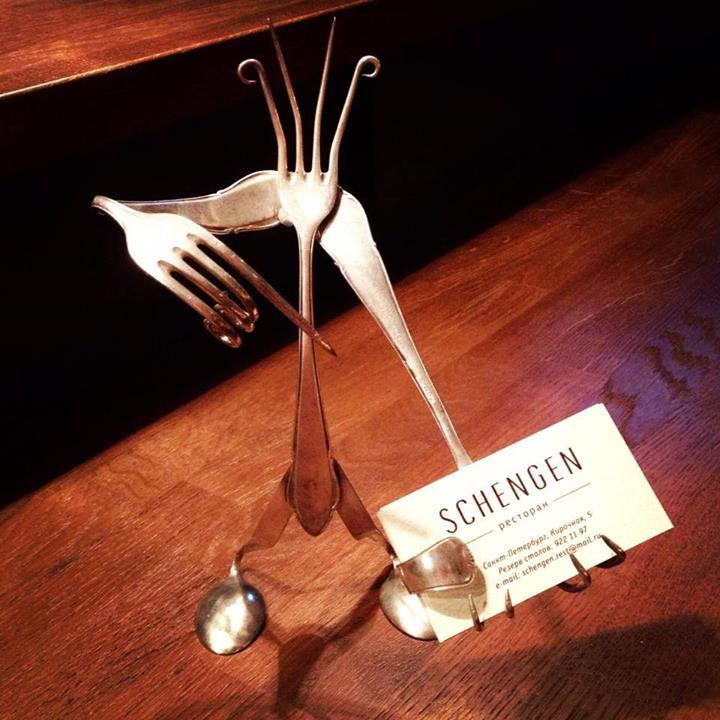
A truly European flavour…
Since last May, Russia has its own ‘Schengen’. It’s a place where you can go for pleasure or business. It’s a restaurant in Saint Petersburg. The restaurant is located not far from the Finnish Consulate, where the owner goes to get “the cherished Schengen visa.” Hence the name. But there is more to it than pure happenstance. The reference to ‘Schengen’ is meant to evoke the cosmopolitan aura that Europe’s area of free movement is supposed to project, together with other related ‘progressive’ notions such as open-mindedness, sophistication, and freedom. This spin is not that surprising. After all, the purpose of any act of ‘branding’ is to sell a product to a customer, and thus the product should be associated with something positive. In the eyes of the management, ‘Schengen’ is supposed to do the trick.
And the trick seems to work. According to one reviewer, Schengen is “a new location for smart people.”. In terms of menu, another reviewer notices how “at first (it) seemed concise to the point of being a bit parsimonious” (these stingy Europeans!), although the overall experience is one of “visa-free satisfaction”. Schengen’s design as well is quintessential European. It has in fact a “slightly Germanic feel” but it “bring(s) together influences from different parts of Europe into an effortlessly harmonious whole”. (Well, “slightly Germanic feel” might be a bit of understatement when we look at Europe today; in turn, the Old Continent is all but “effortless” and “harmonious” these days, but you get the picture…)
From its clientele to its look, Schengen (the restaurant) thus seems to uncannily represent a microcosm of Europe’s border free area, or at least what European policy-makers would like to present outside the region. In this sense, Schengen (the restaurant) is not unique. There are other examples of businesses with topographical names reminiscent of a location that is different from the one where that business actually lies. It is arguably one of the most common practices in the hospitality industry. After all, almost all respectable cities around the world have a ‘London’ or ‘Paris’ restaurant, even if these establishments are located neither in England nor in France. The Schengen restaurant is also not the only bearing a name of topographical entity that does not actually exist. (We should keep in mind that formally ‘Schengenland’ is not a political entity that we can find on a map; in EU legal documents, the reference is still to the territory of member states). Cities are replete with hotels bearing the names of fictional locations, including mythical ones (for example, ‘Paradise’, ‘El Dorado’).
What distinguishes the case of the Schengen restaurant is that it refers to both a real and a fictional entity. The restaurant’s name in fact refers to something that simultaneously does and does not exist. In this context ‘Schengen’ is something real because, according to those who chose this name, its referent object is an existing political entity with defined ‘commonsensical’ features; however, it is also fictional, because this political entity does not formally exist, or at least it does not necessarily exist in the way the management of the restaurant thinks it does. Ready to go to Schengen? Check its menu first, there might be surprises…
Posted by schengenizer on July 31, 2013
https://schengenalia.com/2013/07/31/whats-on-the-menu-schengen-as-a-geo-culinary-topos/
Saying ‘non’ to Schengen: or how a visa refusal can challenge the system

A Non-Schengen ticket…
“Non, merci”. These simple words have caused a stir, embarrassing France and Europe as a whole in the process. What I am referring to is the symbolic gesture that a young Senegalese woman, Bousso Dramé, performed last week after the French consulate in Dakar had granted her a visa to travel to Europe. She really wanted to go to Paris. And she well deserved it (the trip was the prize for winning a French writing contest). Yet, she declined. We often hear stories about visa applicants, especially in developing countries, being turned down by callous European officials. Not this time. Drame turned them down. And she did not do it silently. She wanted to let the consulate officials know why she did it – because of the way she was (mis)treated during the application process. She also wanted everybody else (in Africa and beyond) to know. And she wanted to make a statement about the humiliation that many people like her have to endure in order to get to Europe. That is why she put all her bitterness in writing, in a composed yet powerful j’accuse against a ‘system’ that she feels is profoundly unjust, which pretends to be objective but whose main raison d’être seems to be that of keeping unwanted people out of Europe.
Drame’s gesture has made me think about other symbolic performances that target Europe’s visa system, in this case using art as their main ‘weapon’. What I have in mind is what Milevska calls ‘Non Schengen Art’[1]. The common theme addressed by non–Schengen artists is the impact of the Schengen border regime on the everyday life of Eastern European citizens (those holding passports of countries that are not yet Schengen members). In order to present their work in Western Europe, these artists (themselves citizens of ‘Non Schengen’ countries) need to obtain a visa. To challenge what they perceive as a clamp down on their freedom of expression, they conjure up performances, objects, installations, and video or photography projects that are clandestine attempts for finding a way to trick the political system and bureaucratic procedures. These performances are often based on illegal tactics that mirror the creative ways in which would-migrants try to sneak across Europe’s external borders, such as faking passports, bribing officials, avoiding surveillance cameras, overstaying visas, white weddings, etc. Their criticism of the Schengen regime, rather than overt and outspoken, is evoked by their actions. They are not just representing an illegal migrant in their art; they are performing it. Thanks to these performances, art becomes part of everyday life. But the artists’ objective is not to reify the ‘everydayness’ that Schengen represents, but to disrupt it from within.
The Serbian author Tanja Ostojić, for instance, in her performance Crossing Borders, realized in 2000, the author illegally crossed the border between Slovenia and Austria. When she crossed the border, Slovenia was still a non Schengen country, and its borders with the EU were heavily fortified. According to Ostojić, the journey was possible only because of the help she received from her Austrian friends who accompanied her in the treacherous trek across the Slovenian-Austrian border. The final objective of the work of Ostojić and other members of the Non Schengen Art movement is to unveil Schengen’s exclusionary underpinnings. Their artistic performances thus engage with ‘the system’, if only as a means to debunk it from within. This is precisely what Drame’s ‘spectacular’ gesture seems to be doing. The power of a ‘non’…
[1] Milevska, Suzana, “Non-Schengen art: the phantasm of belonging”, paper presented at the UCL school of Slavonic and East European studies 7th annual international postgraduate conference, Inclusion Exclusion, University College London 16-18th February 2006
Posted by schengenizer on June 29, 2013
https://schengenalia.com/2013/06/29/saying-non-to-schengen-or-how-to-refuse-a-visa-and-the-system-behind-it/
Much ado about nothing..new? On the latest ‘Schengen governance package’

Any surprise in the Schengen package?
Finally! After a tortuous two year gestation, Europe’s triumvirate – pardon, Troika (European Parliament/Council/Commission) -has agreed upon a package of proposals aimed at rendering Europe’s border control regime more effective and predictable. The push for reform came in the aftermath of the spat between France and Italy over the handling of migrants crossing the Mediterranean in the wake of the 2011 Arab spring. The main issue arising from this affair was the need to clarify (and possibly expand) the nebulous rules about the re-imposition of national border controls in cases of “serious threat to public policy or internal security”. At first sight, this seems to be just a technical issue. Only boring policy wonks (like me) could consider interesting (exciting?) questions such as ‘How many days can a member state re-impose border controls?’, ‘Under what conditions?’, ‘How and when should EU institutions be informed?’. What a snooze! Well, maybe not so much. These questions are actually more intriguing than they might seem at first sight. Forget for a moment the technocratic language in which the current public debate about the Schengen governance package has been couched (an art the EU is very good at). If we scratch the surface we can see that at the core this matter is eminently political. And with politics, comes drama! The issue here is the ongoing power struggle among the EU triumvirate over the distribution of competences within the Schengen regime. In other words: who is in charge? How else should we read then the posturing, maneuvering, arm twisting that has characterized the Schengen reform saga in the last two years? (Emblematic here is the EP’s ‘nuclear option’ of boycotting the negotiations over the justice and home affairs agenda if the Council did not withdraw the ‘outrageous’ decision to purge the parliament from the Schengen evaluation process)
This is Schengen politics at its best (or worst, depending on the perspective). Pragmatism, especially the reliance on ad hoc and flexible institutional arrangements and procedures, is in Schengen’s DNA, a trait which Europe’s border control regime acquired in its early intergovernmental days outside the EU and that it has not completely got rid of after its communitarization in the late 1990s. Indeed, I would go a step further and argue that its incorporation in the EU has not really de-Schengenized Schengen; looking at the EU today I see the ongoing Schengenization of the EU, not the other way round…. This pragmatism is only superficially a-political. Political is in fact the move of depoliticizing highly contentious issues by repackaging them as merely technical matters and by sheltering the policy-making process from the public eye.
It is in this pragmatist light that we should read the latest announcement about the Schengen ‘package’. The fact that a compromise was reached (the establishment of an evaluation and monitoring mechanism jointly managed by the European Commission and member states; changes to the Schengen border code to include new circumstances in which border controls can be re-instated) despite the tensions and reciprocal threats and vetoes from the major actors involved in this saga, is not such a miracle after all. That’s how Schengen ‘normally’ works. In the past, bouts of what seem existential ‘crises’ that periodically hit the regime, have been solved (at least temporarily, until a new crisis erupts) with the proverbial political pat on the back. What this solution – political one, since political crises cannot be solved if not through political solutions – comes down to is a revamping of old tacit rules, vague enough so that everybody can see what one likes. This sleight of hand, however, might not overcome the very problems it sought to address, possibly creating new ones. Are we sure member states are going to allow EU institutions (the Commission, Frontex) to assess their ability to manage their borders and accept their suggestions? Will member states really wait for the Commission’s evaluation (which could take up months) before re-imposing internal border controls in the case of another member neglecting to fulfill its duties at the common external border? If the past experience is of any indication, I would not be so optimistic… Indeed, even if the rules of the game have now been more clearly spelt out, it is obvious that they can be interpreted with substantial latitude. With Schengen, the main culprits are typically member states, but EU institutions are quite apt in the art of liberal (i.e. expansive) reading of agreed upon rules. What do we make of all that? Well, the same old story. Schengen has a capacity to withstand phases of internal turmoil, such as the one that followed the Italo-French spat. The way it manages these recurrent crises is as we humans do when under stress (NB: for those who from time to time stumble upon my blog, you’ve probably noticed my penchant for medical metaphors…). What do we do? Typically, we switch to an ‘emergency mode’. We’re ready for the worst, and act as if the worst can happen. We question our routines, and, if needed, we try to tweak them. We make new resolutions to avoid problems in the future. But this is just a temporary coping strategy. Once we are persuaded that everything is OK, we switch off the emergency mode. And then we return to our previous routine. The Schengen triumvirate seems to be following this path, shaking hands and congratulating themselves for the new deal. Until, of course, a new crisis disrupts the newly achieved consensus and we start hearing calls for ‘clearer rules’… The latest Schengen package reform? Much ado about nothing new…
Posted by schengenizer on May 31, 2013
https://schengenalia.com/2013/05/31/190/
The Iron Lady’s Schengen legacy: of commonsense, border fixations and Jacobin hubris
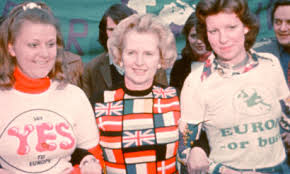
And the Schengen flag too?
It is a bit of understatement to say that Margaret Thatcher was no Schengen fan. In her vitriolic attacks on ‘Europe’ as a political project, she did not spare what she believed was an unnerving and ultimately quixotic quest to dilute, and ultimately dissolve, British sovereignty, a quest concocted by naive continentals, or worse still, by faceless bureaucrats in Brussels. As she put it in the notorious ‘Bruges Speech’, the political manifesto of British Euro-scepticism, “it is a matter of plain common sense that we cannot totally abolish frontier controls if we are also to protect our citizens from crime and stop the movement of drugs, of terrorists and of illegal immigrants.” Commonsensical are also the reasons why national borders should persist: “I did not join Europe to have free movement of terrorists, criminals, drugs, plant and animal diseases and rabies, and illegal migrants”. (Certainly not the Europe of peace and goodwill that Jean Monnet envisioned…) In Thatcher’s ‘commonsensical world’, the triad borders/security/state is so ingrained in our collective understanding of what border control means as to not require further explanation. Borders and security are indissolubly linked, and national governments (as opposed to supra-national institutions) should be in charge of this issue. From this perspective, Schengen can only be an aberration.
And yet, despite her visceral opposition to continental Europe’s experimentation with territoriality, Margaret Thatcher has played a fundamental role in the making of Schengen as we know it today. The Iron Lady’s trenchant critiques have set the terms – and the tone – of the debate about this eminently political project. Schengen supporters (be it in Brussels or in European capitals) have had to come to terms, adapt and respond to the ‘nationalist backlash’ that she so powerfully and persuasively unleashed. The former British prime minister also embodied one of the major obstacles (yet to be fully overcome) hindering the full realization of a post-national vision of territoriality in Europe, namely the persistence among European policy-makers and the population at large of what I call ‘border fixation’. Despite claims that traditional territorial boundaries are ‘passé’, borders have not lost their appeal. For some commentators, this fixation is baseless. First of all, advocates of hard borders tend to exaggerate the demand for them. Uncontrollable mass movements of population across frontiers are, after all, rare events. Moreover, borders cannot (and arguably never did) effectively achieve one of the main goals they were established for, namely, preventing unwanted entries into a territory. These arguments are well founded, but they do not take into consideration that the appeal of borders does not stem (or at least not solely) from their ‘material’ functions; instead, it is based on the powerful psychological need for order and stability in a community. The leap required to go beyond this border fixation would therefore entail the embracing of a new type of post-territorial governance where this need is addressed in a different fashion. Europe is not new to far-reaching and ‘unimaginable’ transformations. The Old Continent is a constant work in progress, an open-ended experiment that has been re-adjusted in light of new events or circumstances in the past. Yet, given the current gloomy and inward looking political climate, the conditions to overcome the long-lasting fascination with borders do not seem ripe. And even if they were, we should nonetheless heed to Margaret Thatcher’s admonition about the Jacobin tendencies (viz. radical and hyper-rationalist) that she so strongly despised in the European project:
“…look at the architecture of the last fifty years — look, in particular, at the architecture that went beyond the modern to the futuristic. It was certainly a very dramatic architecture but the one thing it no longer expresses is the Future. What it expresses is yesterday’s vision of the future. C’est magnifique, mais ce n’est pas la politique.”[1]
Schengen’s ‘architects’ seem to have listened to Thatcher’s warning about Europe’s institutional hubris. One of the policy regime’s signature traits is in fact its flexible and pragmatic design, which has allowed it to withstand turbulent times, wobbly political will and recurrent bouts of skepticism during its three decade long history. The Iron Lady would probably balk at the idea, but helping Schengen thrive might well be part of her vast political legacy…
[1] Margaret Thatcher, “Europe’s Political Architecture”, Speech in the Hague, May 15, 1992, Thatcher Archive
Posted by schengenizer on April 8, 2013
https://schengenalia.com/2013/04/08/the-iron-ladys-schengen-legacy-of-commonsense-border-fixations-and-jacobin-hubris/
Schengen blues: critical (musical) notes on Europe
 There’s something about Schengen that makes it a favourite subject of creative types of all stripes. What this ‘quid’ consists of may elude us non artistically inclined mortals. After all, what can be so exciting about an utterly dry catalogue of rules regulating travel in and about the Old Continent? Apparently, a lot. The reasons why Schengen has become a source of artistic inspiration, however, are not necessarily as benign as some European policy-makers (especially those who still hail this policy initiative as one of the finest achievements of European integration) would like us to believe. Indeed, Schengen is often the artistic target of trenchant criticism, especially because of its exclusionary practices vis a vis selected individuals (i.e. the unwanted non-Europeans). This critical streak permeates the entire spectrum of the performative art scene. Musicians play a big part in this anti-Schengen chorus. Europe’s free travel area seems to touch a (metaphorical) cord with this category of artists. After all, is there a better way to voice your opinion (and be heard from afar) than through your own voice, especially if screamed out of your lungs? The latest example of this increasingly popular musical genre (‘Schengen blues’?) that I have recently come across is from the Spanish crooner Raphael (by the way, why would the author of 60s’ hits such as “Cuando tú no estás”, “Mi gran noche”, “Tema de amor”, would pen a song – in French, alas! – on a topic such as Europe’s border control regime is a question that definitely warrants further investigation…). The song, simply titled ‘Schengen’, poetically evokes the painful experience of the typical migrant living in the Old Continent. The result is a rather depressing portrayal of Europe…
(…)
Tellement de nuits sous la paupière
Tellement de forêts abattues
Même sous la mitraille et le fer
Moi je leur ai rien vendu
Et que même dans l’espace Shengen
Ils ont pas voulu de ma peau
Ce que j’ fais là moi
Je sais pas
Je voulais juste marcher tout droit
Ce que j’ fais là moi
Je sais pas
Je pense à toi depuis mille ans
(…)
(NB: full text and English translation are available here)
Posted by schengenizer on February 28, 2013
https://schengenalia.com/2013/02/28/171/
Is it just an illusion? On Europe’s ‘common’ migration policy
The question of the role and impact of the European Union and its institutions on European politics has been at the core of major political and academic debates since the project of regional integration was launched more than 60 years ago[i]. It may be a sign of the (troubled) times that the discussion now seems to be turning to the more ominous issue of whether the EU is relevant at all, or, in the most apocalyptic scenarios, whether it can survive its current state of economic and political turmoil. Until recently, few commentators would have explicitly pondered the ‘relevance question’ in such pessimistic terms.
Of late, however, EU-bashing is no longer the extremist activity it used to be in the (not so distant) past, with a few mainstream voices joining the chorus. As a result, ‘Brussels’ is being blamed for all kinds of ills affecting the continent. The response to the EU’s recent Nobel Prize award is revealing. For some, it was well-deserved, given its important contribution in rendering the Old Continent a less belligerent place, although even the most ardent Europeanists would admit that the timing of the award was a bit awkward. For others – arguably the majority of commentators – this award bordered the blasphemous, given the Union’s current economic and political predicament.
Without doubt, opinions of the European Union are strong and polarized. These reactions, whether they are polemical or hagiographic, often share a lack of sound argumentation and solid empirical evidence to back up their claims. It is for these reasons that I have found Suzanne Mulcahy’s book Europe’s Migrant Policies a particularly welcome addition to the debate about the Union’s relevance in contemporary European politics. The book assesses the role that the EU is playing in the development of common migrant integration policies across the continent. The author focuses on three of the key components of this policy area (immigrant integration, civil integration, and migrant enfranchisement) and examines how their main principles have been elaborated, negotiated and implemented by EU institutions and member states. Since the 1990s the EU has been particularly active in fostering a common approach in this policy area. As Mulcahy argues, however, not only has actual convergence has been limited, but the EU has also not played a major role in this process – even when convergence around EU norms has indeed occurred. On one hand, member states have chosen different paths (some following EU standards, others their own ‘national’ approach). On the other, the convergence (or lack thereof) around common European principles and practices (such as the Common Basic Principles agreed in 2004) has had more to do with internal factors, such political culture and the containment of extreme right-wing parties, than EU institutions and their actions. Hence the claim that integration in this policy field is an illusion.
These findings are a cautionary tale for those who believe in the power and inevitability of European integration. They also challenge some of the Europeanization literature’s central claims, especially those of the so-called ‘downloading’ model (according to which policy convergence is mainly a EU-driven phenomenon), but also the more nuanced ‘Interactive Europeanization’ model in which policy convergence is the result of a sort of virtuous cycle involving both member states and EU institutions. The author does not find evidence of either of these dynamics affecting migrant policy in Europe. Mulcahy concludes that unless the EU backs up its ‘soft law’ approach with more legally binding instruments (as it has been the case for other policy areas such as discrimination) then the prospects of convergence in this policy realm will remain grim. The same dynamics affecting migration policies may also hold true in other areas of European integration, and thus a more sophisticated reading of their evolution which takes seriously the domestic politics dimension is required.
The argument presented in Europe’s Migrant Policies is nuanced, theoretically sophisticated and based on empirically rich material from a variety of country case studies. The bleak picture Mulcahy paints of Europe’s allegedly ‘Europeanized’ migrant policies is thus persuasive and consistent with the current generalized disillusionment with the European integration project. Yet, while understandable, the pessimism that transpires in the book may be overstated. By using the claims of the interactive Europeanization literature as a point of reference, the author has implicitly set the standards high. Indeed, compared to other policy fields, EU-led integration in migration matters has been disappointing. A different picture emerges, however, if we consider the specificities of the migration field in Europe and the political dynamics that underlie it. After all, migration has been, and to a large extent still is, the domain of member states. Despite the recent expansion of EU competences in Justice and Home Affairs (under which migration mostly falls), national capitals are still reluctant to delegate responsibilities in this policy area because of the sensitivity of the subject matters it deals with. As a result, the EU still lacks effective legal and political instruments to compel member states to establish and implement common European norms. Given this, it is surprising that any EU-led convergence – or, for that matter, convergence in general – is occurring at all.
While migrant policy in Europe may indeed be suffering from an ‘illusion of integration’, this state of affairs does not need to have the negative connotations typically associated with this term, namely that of distortion or misinterpretation of facts. Most European policy-makers (and pro-integrationist commentators) are well aware that greater integration is a not a straightforward, effortless endeavour, and that in order to overcome practical and political obstacles, pragmatism needs to be matched with a degree of long term visionary thinking. Migrant policy is not an exception to this rule. Despite its current foes, a degree of illusion is what this policy field might need after all.
[i] A version of this blog entry has appeared in the London Schools of Economics’ on line Review of Books.
Posted by schengenizer on January 31, 2013
https://schengenalia.com/2013/01/31/is-it-just-an-illusion-on-europes-common-migration-policy/
 Schengen-alia